


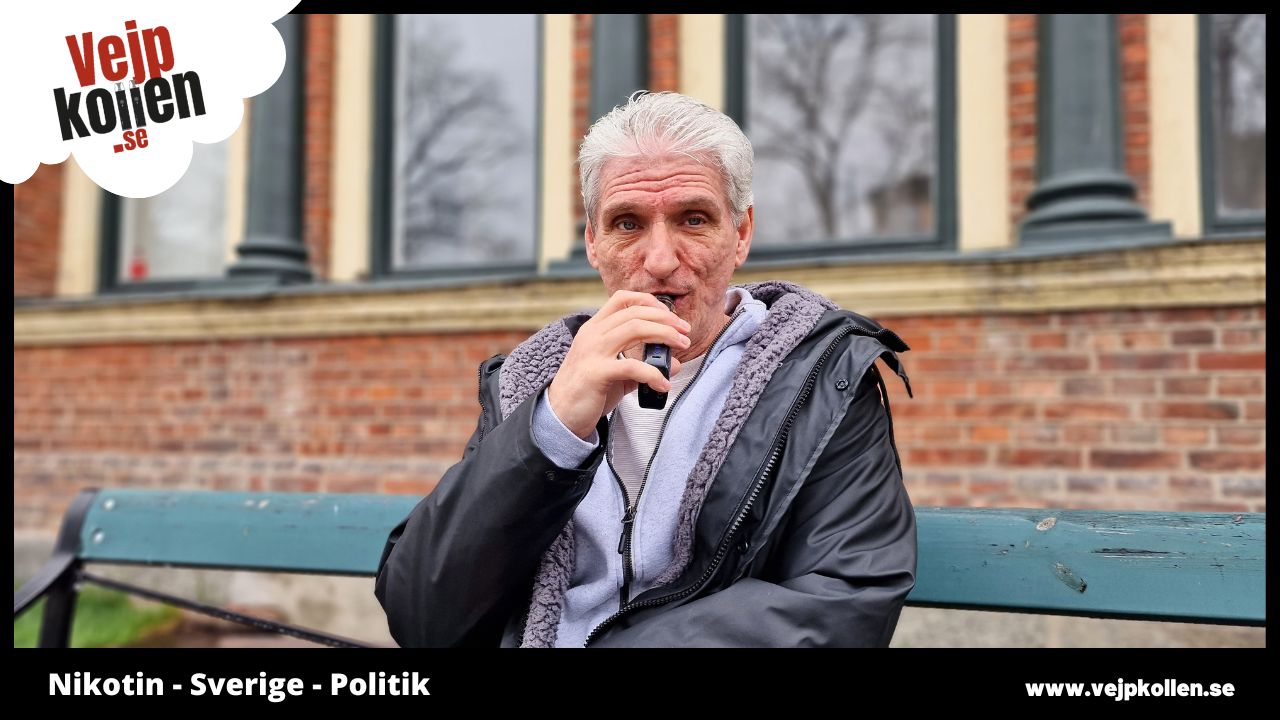
According to statistics, only 6 per cent of the Swedish population smokes, give or take a little depending on education and place of residence. Whichever way you look at it, this is much lower than in the rest of the EU. Nevertheless, nicotine use is as widespread here as in other countries. Why is this and what kind of nicotine products do Swedes actually use? This is the first instalment in a series of portraits of Swedes who no longer smoke.
First up is Björn Åslander, 59-year-old vejpare from Hallsberg.
- UIn the spring of 2023, the Road studs with Convenience Stores Sweden News to depict Swedish nicotine consumption, bortom statistics. This report is a slightly modified version of the original report which was published in CSS News. —
The first time we met, he was angry as a bee. I was working behind the counter in a vejp shop in Gothenburg and Björn Åslander almost fell through the door, fleeing an unusually angry rain. He had been vejping for almost a year at that point. It was no walk in the park. The coil kept burning, the tank was leaking and didn't the e-juice suddenly taste a bit different?
"They haven't gone and changed the recipe, have they? It doesn't taste as it should. It just pisses me off! Why do they have to do this?" Björn muttered as he stood dripping at the checkout counter.
That's the way it was. After that we met once a month. Built a relationship that revolved around vejping, problem solving, non-smoking, different flavours. And a lot of politics.
This is his story. 8 years later.
Forest, house and shepherd
When we first met on that rainy day in 2016, he was working at a printing company in Gothenburg. Today, Björn Åslander is a trained bus driver and has moved to Hallsberg in central Sweden. There is still a bit of winter in the air when we meet in the little red cottage that Björn rents with his partner Therese, a few kilometres south of Hallsberg. He has already turned 59 when we get out of the car, in the middle of the forest where the couple's German shepherd runs around collecting sticks.
"She's crazy about sticks, completely manic," says Björn, puffing on his relatively large e-cigarette on the veranda. A cloud creeps in between the bushes.
My father smoked a cigar
He started smoking cigarettes early. It was in the 1970s. Dad smoked cigars, mum didn't smoke at all. A fairly normal Swedish home, but far from a smoking family," says Björn.
"Dad smoked cigars a few times a month, but no more. I had started to smoke a little bit on the sly and he caught me, I think it was the neighbour gossiping. Then he forced me to smoke a whole cigar in the toilet. Damn, I coughed and vomited. He really didn't want me to start smoking."
I ask if it worked. Björn laughs.
"No, it really didn't. I don't remember exactly, but I smoked regularly in the 7th grade. Bought those little packs, Glen, wasn't that what they were called back then? It was me and a few mates who did it. Some also snuffed it. I remember a guy, Jan Johansson, who stole a can at ICA and got caught. He was that cool guy on the moped, without a helmet and a cigarette in his mouth."
"One of the good things in life"
Björn describes smoking as an important part of socialising. His friends smoked in the smoking area at school. Later in life, they would meet and have a cigarette during breaks at work.
"I was never a pub-goer, but I used to meet friends at a café after work. Then we chilled. And had a cigarette, of course. It was one of the good things in life, at that time."
Painters, printers, smokers
At the time of our interview, he had just completed his training as a bus driver and had recently moved to Hallsberg, where his partner Therese has her roots. But he was born in Stockholm 59 years ago and moved to Gothenburg in the mid-1980s. Smoking has stayed with him and he has worked in many professions, ranging from printing to painting with his own company.
"When it comes to smoking, I think a lot about what I experienced as a painter. I was involved in cleaning up many flats where someone had been smoking cigarettes for decades. The smoke particles settle deep in the walls. The stains are tricky to cover, not to mention the odour, which is very difficult to remove. Good job for a painter, though, especially if you get paid by the hour," he laughs.
But then it gets a bit serious again.
"I can't believe I've had that stuff in my lungs for so many years."
No thought of quitting
"He had no intention of giving up smoking," he says. That it turned out that way was mostly a coincidence. He smoked more than a pack a day, basically every day since the age of 15.
"A woman working as a trainee at the printing company where I was employed turned up one day with an e-cig. It turned out that neither she nor her husband, whom I knew slightly, had smoked for a few months. They had each bought an e-cig instead. She stopped by our house later. Me and Therese, who also smoked (her partner, ed. note) became curious and started to check out what it was. Then I was sold," he laughs.
A lot of experimentation
At that time, in 2015, few e-cigarettes were available outside specialised shops. It was only when disposable models became popular that e-cigarettes appeared in every single convenience store.
"It was a bit tricky to understand how it worked with e-liquid and different devices. But I stuck with it. It's important to get good help. In some shops they tried to push anything on you, either something unnecessarily expensive or e-liquid with too high or too low nicotine strength. There was a lot of experimentation in the beginning before I found the right one."
"New models all the time"
He has a whole box of different vejp devices in a cupboard in the kitchen. Some new, some older. Even an Iqos - a variant of an e-cig that vaporises tobacco instead of e-liquid. He picks up some old tanks. Favourites that cannot be used anymore - not because they are worn out - but because spare parts are not available.
"The problem with e-cigs is that new models are coming out all the time. Parts that you need to change, like coils and glass for the tanks, stop being produced and then you're stuck. For me, it can take time to find something new that suits my way of vejpa" says Björn Åslander.
"Very picky about the flavour"
Today he uses several models in parallel. A high-power device that produces large clouds during the day. A small version, a so-called pod system, at home in the evenings.
"If I vejpake the big machine under a smoke alarm, and yes, that has happened, then the alarm goes off. Not good," he laughs. "But it doesn't happen when I use the small pod system. It's more like smoking a cigarette in feeling, more nicotine but less vapour."
Apart from the device itself, the flavour of the e-liquid is "extremely important", he says.
"Yes, my God. I'm very picky. There has to be a lot of flavour. And I want it to be reminiscent of smoke too. At least a little bit."
The same e-juice for many years
E-juice, whether it comes in a large vejp or disposable model, is made up of the same ingredients. Glycerine and propylene glycol. And flavours and nicotine, of course. Tobacco flavours are actually the collective name for a range of different flavours. Some are more like chocolate or vanilla, while others have profiles like liquorice or crackers. Once Björn found a flavour from a local producer in Uddevalla, he has stuck to it. For many, many years.
"I have tried other flavours too, but it doesn't work. Disposable models are everywhere these days and of course I have tried some. My problem with it is that they are so sweet. And many of them taste like candy. It might work for a day. But then I get tired of it," he says, admitting that he recently found a sweet fruit flavour that he likes better in the little pod system he uses in the evenings.
"But it turns out that that particular e-juice was hard to get in Sweden, typical, somehow," he laughs.
The debate on nicotine
Ever since e-cigarettes appeared on the market, almost 20 years ago, the technology has been a source of debate. After all, it is about nicotine - an addictive substance that is inextricably linked to smoking. Smoking a packet a day for 40 years increases the risk of a range of life-threatening diseases. Burning tobacco and smoking it means inhaling thousands of dangerous substances, in particular soot particles and carbon monoxide. At the same time, cigarettes are one of the world's best-selling products.
A fraction of the toxicity
The modern e-cigarette was created by a smoker, a Chinese pharmacist who wanted to find a way to inhale nicotine without burning tobacco. He solved it by heating glycerine and propylene glycol with added nicotine. The nicotine was the same as in proven nicotine drugs - he was, after all, in the pharmaceutical industry - and the result was a battery-powered vaporiser, a "vejp" vaporizer, which heats a so-called e-liquid to about 250 degrees. The vapour was found to contain a fraction of the toxic substances found in cigarette smoke, and no trace of either carbon monoxide (which causes cardiovascular disease) or soot particles (which cause cancer and COPD). Smokers also seemed to enjoy using the technology.
Difficulty with information
The problem of smoking solved, right? No, not really.
Despite the technology being classed as a much safer way to use nicotine than smoking, the debate between researchers, interest groups and an established tobacco control apparatus has been raging for almost 20 years. As a result, the most basic information on the risks of e-cigarettes versus cigarettes is difficult to access today, to say the least.
This is particularly true for smokers.
Discussions in the smokebox
Björn often encounters irritation and even aggressive comments, he says. Not infrequently in the smoking areas. From smokers.
"Well, there you are, breathing in chemicals. That's dangerous, I've heard that it's worse than cigarettes...". I hear that often. And the people who say it SMOKE like brushbinders. It drives me crazy. You have to explain what vejpning is and what the difference is. But it's not easy when you stand there in a wild discussion and have five minutes," says Björn Åslander.
Reducing risks - but few know it
According to studies in the UK and the US (and to some extent in Sweden), knowledge about e-cigarettes is rarely based on actual evidence. According to the British health authorities, who have summarised the research on e-cigarettes since 2015, vejpning, whether it is a single-use model or a larger device, reduces the risk of nicotine addiction by almost 95 per cent for smokers. However, in statistical surveys, many smokers, close to 50 per cent, currently believe that using e-cigarettes is as or more harmful than smoking cigarettes.
"Could breathe normally again"
E-cigarettes and vejping simply evoke emotions. Björn Åslander thinks the whole discussion on e-cigarettes has been distorted.
"It gets frustrating to hear all the nonsense all the time. When some organisation spreads fear-mongering that there are risks and that we 'don't know' enough. I know how my health changed from when I swapped the cigarette for my vejp. I could breathe normally again. My doctors noticed it too, when we compared my spirometry readings between years. Huge difference. Then it doesn't matter what others claim, or try to "prove" says Björn.
"Will not smoke again"
After all, he believes that e-cigarettes will replace cigarettes even in tobacco shops. At least in the not too distant future.
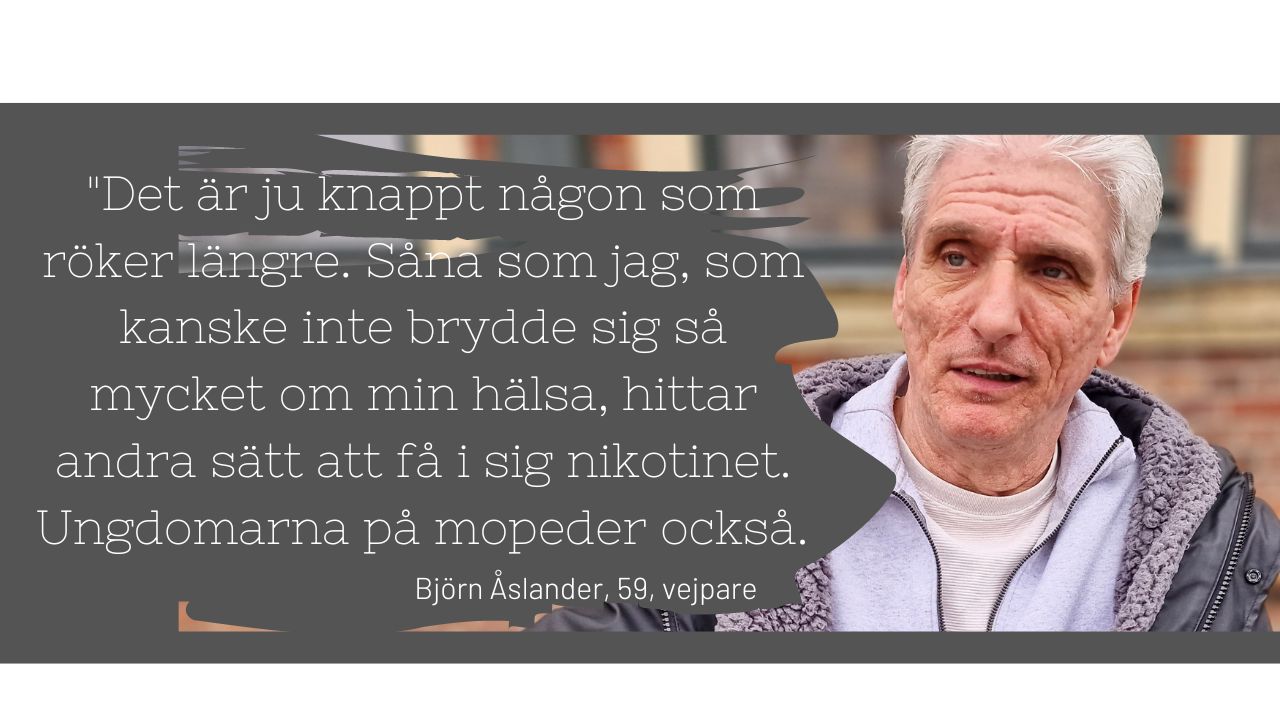
"Hardly anyone smokes anymore. People like me, who maybe didn't care so much about their health, find other ways to get the nicotine. Young people on mopeds too. I don't smell smoke anymore, don't bother anyone else - it makes it more acceptable. Strangely enough, I still think the smoke from cigarettes can smell good and I usually have a puff now and then. But that's the thing here, it gives me nothing anymore, no flavours, nothing. I won't be smoking again, I know that." says Björn Åslander and blows a small cloud that mixes with the drizzling rain in the forests south of Hallsberg.