


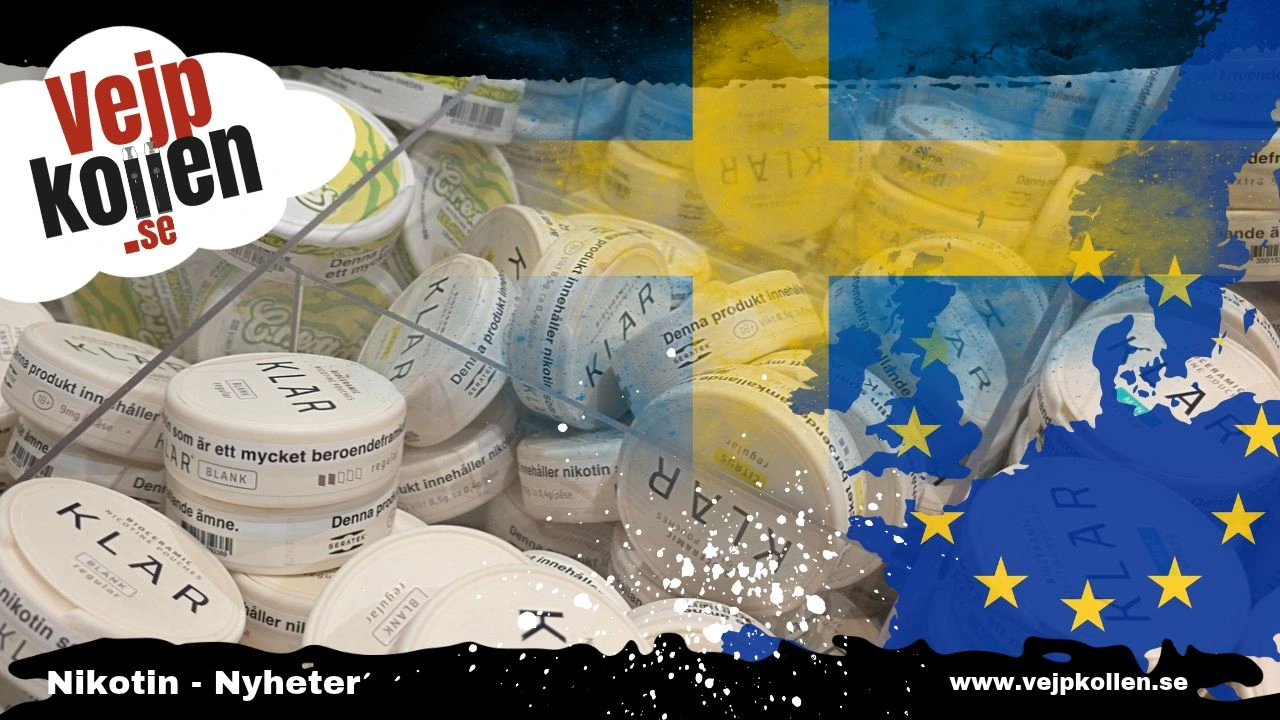
Employers and trade unions are now putting forward similar demands ahead of the EU’s forthcoming reform of nicotine legislation. Following warnings from 201 European companies and organisations to the European Commission about the consequences of new regulations, four Swedish industrial trade unions are now calling on the parties in the Riksdag to agree on a strategy to defend the Swedish snus and nicotine industry.
”We are not defending companies” profits or products. We are defending our members’ jobs. Sweden must now agree on a common approach to industrial jobs.”
This is stated by the chairpersons of the Food Workers’ Union, IF Metall, the GS Union and Pappers in a joint opinion piece in *Dagens Industri*.
One of the reasons for this is that eight EU countries – the Netherlands, Belgium, Finland, France, Hungary, Latvia, Slovenia and Spain – called in October for the EU’s forthcoming Tobacco Products Directive to allow individual Member States to impose a total ban on the sale of white snus.
”The threat is clear. Thousands of jobs, exports and investments are at stake,” write the trade unions.
Jobs in several Swedish industrial towns
According to a report by the employers’ organisation Livsmedelsföretagen, the Swedish snus and nicotine industry employs around 3,300 people directly and nearly 10,000 across the entire value chain. The value of exports amounts to nearly seven billion kronor a year.
The jobs are available in places such as Gothenburg, Kungälv, Malmö, Sävsjö, Vårgårda, Upplands-Bro and Enköping.
”Behind the figures are our members, their families and local communities. The proposals have not yet been finalised, but a total ban could have a negative impact on jobs, exports and investment. Swedish companies and employees have built up a highly skilled export industry. Other EU countries” ban policies risk closing off important markets for Sweden.”
Criticises the Ministry of Social Affairs
The four trade unions have also criticised Sweden’s approach to date regarding the EU’s forthcoming Tobacco Products Directive, TPD3.
When the European Commission sought views from the Member States, it wanted, amongst other things, information on how new rules might affect employment.
”The Ministry of Social Affairs” response was 24 pages long but lacked a concrete account of how thousands of Swedish jobs might be affected. That is more than remarkable. Who is going to defend Swedish industrial jobs in Brussels if Sweden itself does not?”
The trade unions are now calling for an independent impact assessment to show how the EU’s proposed taxes and product regulations might, taken together, affect Swedish jobs, production, investment and exports. The assessment should also highlight opportunities to develop industry and create new jobs.
The same arguments from the companies
As Vejpkollen recently reported, 201 companies and organisations within the European tobacco and nicotine industry have written directly to the President of the European Commission, Ursula von der Leyen, with similar demands.
According to the signatories, the sector employs over 1.5 million people across the EU. Businesses also want the impact of new taxes and product regulations to be assessed collectively, rather than individually.
Trade unions also share the concerns of businesses that bans and far-reaching restrictions will encourage illegal trade.
”We want a regulated market with clear rules, effective supervision and Swedish industrial jobs – not bans that risk replacing legitimate jobs with undeclared ones,” write the union chairmen.
At the same time, they want to see stricter enforcement of age limits, a ban on selling alcohol to under-age people, and restrictions on marketing that appeals to young people.
”Sweden’s experience of reducing cigarette smoking can be of help. Regulation must be based on evidence and take into account both health and employment.”
”Sweden is forming a government. But the EU won’t wait”
Negotiations on new harmonised nicotine taxes within the EU have not yet led to a final decision. Meanwhile, the European Commission is expected to present its proposal for a new Tobacco Products Directive around the turn of the year.
Unlike the tax issue, amendments to the Tobacco Products Directive do not require unanimity amongst Member States. Sweden is therefore unable to block a proposal on its own.
The four trade unions are now calling on the parties in the Riksdag to agree on a Swedish position and for the Government to actively seek support from other Member States.
”Trade union solidarity means that we stand up for each other’s jobs, even when the issues are politically difficult. We do not need to agree on every detail of nicotine policy. We have built up a world-leading Swedish industry. Now politicians must take responsibility for ensuring that it also has a future.”
The opinion piece is signed by Nataša Stojković of the Food Workers’ Union, Marie Nilsson of IF Metall, Madelene Engman of the GS Trade Union, and Pontus Georgsson of Pappers.


