


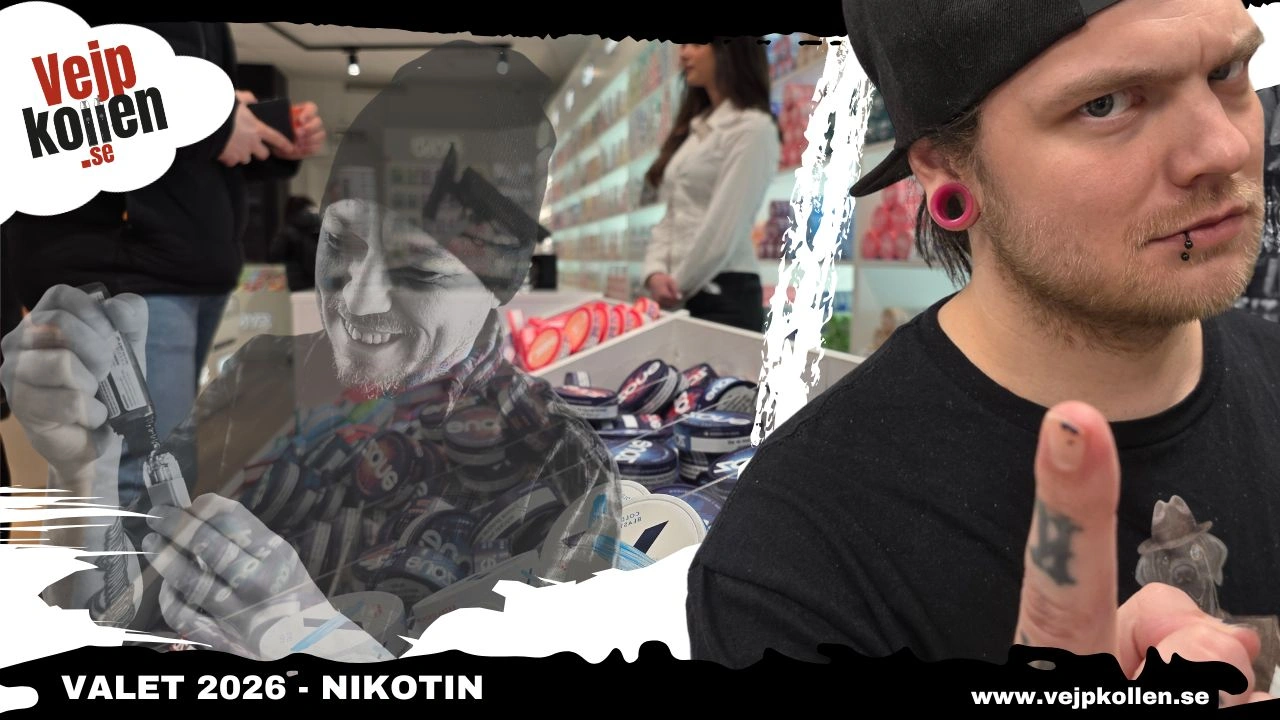
Three days before the election, Linus Gustafsson is at a vejp fair in Fittja, talking about flavours, e-cigarettes and politics. For the entrepreneur and vejp user, the issue has become bigger than his own industry. He describes the 2026 election as a decisive one for users of smoke-free nicotine – and is concerned about how quickly the rules of the game could change after election day.
For anyone who enjoys the flavours in their vejp, e-liquid or white snus, Sunday’s vote is a truly decisive one.
At any rate, that is the view of Linus Gustafsson, a vejp enthusiast, e-juice manufacturer, entrepreneur and prominent figure in the vejp world.
“I don’t think many people realise how little it would take for a proposal that more or less bans all flavours in our nicotine pouches and e-cigarettes to be pushed through. It would spell the end for all companies that aren’t tobacco firms, and be a blow to users and the shops they buy from,” Linus Gustafsson tells Vejpkollen when we meet at a trade fair in Stockholm a few days before the election.
Taste became a political issue
Ever since the previous Social Democratic government attempted to ban all flavourings in e-liquids, Linus has been on the front line. The flavourings were saved by the skin of their teeth, following several low-budget campaigns – videos, leaflets and petition drives. The opposition eventually voted down the proposal. But since then, new proposals have surfaced at regular intervals in the Riksdag. And now it’s not just about e-cigarettes.
“As recently as last spring, the Left Party tabled a proposal to ban flavours in white snus. It was a carbon copy of the proposal we managed to get scrapped for e-cigarettes a few years ago. They just won’t give up,” Linus Gustafsson told Vejpkollen.
Has been reviewing the policy since 2010
According to Linus Gustafsson, it is certainly clear where the various parties stand on the issue of a ban. The Left say yes. The Right say no. But it is a fine line, he argues.
“When I go through the debates and motions – and by that I mean everything that has been said and written in the Riksdag regarding smoke-free nicotine and tobacco since 2010 – it becomes clear that there have always been individuals in every party who take a very negative view of anything to do with nicotine. Of course, many parties are happy to use the term ”harm reduction’ in their public statements, but in practice it can tip over into a ban of some sort at any time,” says Linus Gustafsson.
Using a fairly simple AI prompt, he has tried to get an overview of the political parties’ stance on snus, e-cigarettes and nicotine in general. The conclusion is that Swedish policy on nicotine is rather confusing.
“In short, it boils down to the Left Party preferring to ban everything first and investigate later. In other words, they are prepared to first destroy an entire market for people and businesses and then “take a quick look at the devastation” they have caused. Quite a strange attitude. The Social Democrats, on the other hand, do not even want to carry out an investigation. They are ideologically opposed to anything to do with nicotine and have no interest in scientific evidence that contradicts their views. ”They have been voting in favour of every ban relating to snus, e-cigarettes and nicotine pouches for a very long time. I doubt there are many Social Democratic Zyn and Velo users who are aware of that,” says Linus Gustafsson.
Sees the election as a decisive one
According to Linus, the 2026 election will therefore be a decisive one for those who, for whatever reason, use smokeless nicotine. When Vejpkollen has summarised the parties’ current positions on the nicotine issue, it certainly appears that a majority of the parties actually support, for example, flavourings in nicotine products.
“The parties that have been most consistent on this issue are the Moderates and the Sweden Democrats. They talk about minimising harm and the value of maintaining diversity in the market. They have also put forward their opposition on the basis of impact assessments, which over the years have proved to be entirely accurate. One example is the Moderates” objection when the current ban on online marketing and sales was passed. At the time, they warned that this would lead to severely distorted competition between companies, depending on which municipality they were based in. The Moderates warned of chaos and entrepreneurs being caught in the middle. And that is exactly what happened. So the Moderates are doing a good job, I would say.”
He also regards the Sweden Democrats as the party, alongside the Moderates, that actually takes the issue of harm reduction seriously.
“The SD has in fact gone to the trouble of drawing up its own ANDTS strategy based on harm reduction, with the aim of eliminating smoking. That is worth mentioning,” says
Linus Gustafsson.
The centrist parties are wavering
But then things get complicated, says Linus Gustafsson. He considers the centrist parties – the Centre Party, the Christian Democrats and the Liberals – to be extremely unreliable when it comes to minimising damage. .
“C justifies its opposition to a ban on the grounds of free-market principles, not public health. Quite simply, it is no longer the snus-smoking farmers” party it once was,” observes Linus Gustafsson, continuing:
“The Christian Democrats came close to doing a complete U-turn at their last party conference. The leadership wanted to ban flavours in nicotine pouches. That proposal was voted down, but what will happen in the future?”
Even the Liberals, who are usually clear on issues relating to market liberalism, are a bit vague, according to Linus Gustafsson.
“The Liberals are a fairly small group in the Riksdag, and on paper they are in favour of harm reduction. But at the same time, it depends very much on who is sitting on the Social Affairs Committee at the moment. It could suddenly be an anti-nicotine activist – and how would the vote go then? A vote for the Liberals is a gamble, I’d say.”
”Far more people than many realise”
In the run-up to the election, Linus Gustafsson believes that the issue of nicotine is likely to affect far more people than many realise. Two million Swedes currently use nicotine. Of these, nearly one and a half million are snus users, and a growing proportion of them use white snus.
“Above all, I think it’s important that those who vote for the Social Democrats or the Green Party realise that these parties won’t stand by you when it comes to your snus use, especially if you like white snus. They could ban your favourite flavour straight away without even going through the usual channels.”
But it seems the Social Democrats have changed their stance somewhat on nicotine pouches, hasn’t it? Surely there are people in the party who are defending these products now in the run-up to the election?
“Yes, but that doesn’t mean they’ve fundamentally changed their minds. And it certainly doesn’t look that way if you look at how they voted, most recently this spring. You can always hope, of course, but to the left-wing snus users who are still on the fence, I say: Is it worth scrapping the waiting day if the price you pay is a massive tax hike on your white snus, which, on top of that, will only be allowed to taste of artificial tobacco?” says Linus Gustafsson, chuckling a little.”.
“Do you want to keep your loose snus, or do you want to give up snus? It might sound a bit clichéd, but that’s what this election is all about. When you go to the ballot box, you’re not just deciding who gets to form a government, but whether you’ll be able to keep your white snus and your vape.”


